 Blakney Terica
Fashion design often begins with instinct. A color combination feels exciting, a fabric suggests movement, or a silhouette appears in the mind before it has a name. That first spark matters, but it is only the beginning. To become a designer, creative interest has to become a repeatable process: research, sketching, fabric study, pattern development, fitting, revision, and presentation.
For emerging designers, this transition is one of the most important stages of growth. It is the point where fashion stops being only inspiration and becomes a discipline. A strong designer does not simply imagine beautiful garments. They learn how garments are built, how they move on the body, how they communicate identity, and how they can be presented as part of a coherent collection.
Fashion Design Starts With Observation
Before a designer can create strong work, they need to learn how to look carefully. Clothing is not only decoration. It is connected to movement, culture, comfort, weather, social settings, personal identity, and daily routine. A jacket designed for a city commute has different requirements from a dramatic runway piece or a relaxed weekend dress.
Observation helps designers understand real needs. What do people wear often? Which garments make them feel confident? Where do clothes fail: poor fit, weak fabric, awkward pockets, limited movement, difficult care, or unclear styling? These details can become the starting point for better design.
Beginners often focus first on style, which is natural. But style becomes stronger when it is supported by function. A garment should not only look interesting in a sketch. It should make sense on the body and within the life of the person who wears it.
A Clear Concept Gives Direction
A fashion concept gives a project its structure. It explains what the collection is about, which mood it carries, and why certain shapes, colors, fabrics, and details belong together. Without a concept, a designer may create several attractive pieces that do not feel connected.
A concept can come from many sources: architecture, music, nature, film, memory, street style, historical dress, craft traditions, or social questions. The important step is translation. A designer should not copy a reference directly. They should transform it into a fashion language through proportion, texture, line, and construction.
Good concepts are often focused. Trying to include every idea can weaken the collection. Emerging designers benefit from editing their inspiration. A limited palette, a repeated shape, or a consistent material story can make the work feel more intentional.
Sketching Is a Thinking Tool
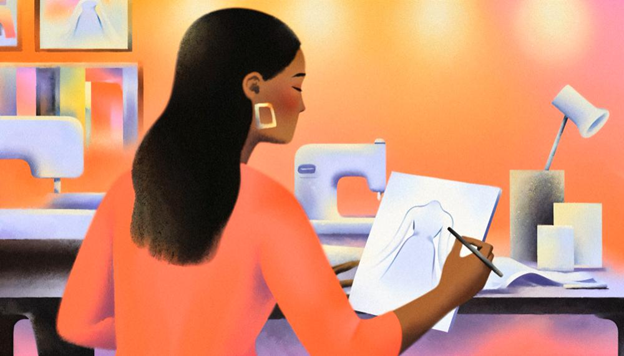
Sketching is not only about drawing beautifully. It is a way to test ideas quickly. A sketch can reveal whether a sleeve feels too heavy, whether a neckline fits the mood, or whether a garment needs more balance. The more variations a designer creates, the more options they have before moving into construction.
Early sketches do not need to be perfect. They need to be useful. A designer can draw front and back views, detail studies, fabric notes, seam ideas, and styling possibilities. These drawings become a bridge between imagination and technical development.
Over time, sketching also helps designers build a visual voice. Repeated practice improves proportion, line confidence, and clarity. Even designers who use digital tools benefit from hand sketching because it keeps the creative process fast and flexible.
Pattern Making Turns Ideas Into Garments
A fashion illustration becomes real only when it can be translated into pattern, fabric, and fit. Pattern making is one of the most practical skills a designer can learn. It teaches how flat pieces become three-dimensional garments and how seams, darts, panels, gathers, and volume shape the body.
Fit is not a minor detail. It affects comfort, movement, confidence, and quality. A garment can look strong in a drawing but fail if the proportions do not work on a real body. This is why fittings, mockups, and adjustments are part of professional design.
Revision should not be seen as a mistake. It is how garments improve. A prototype may show that the shoulder needs adjustment, the fabric is too stiff, or the length changes the entire feeling of the piece. Each correction makes the design more resolved.
Materials Shape the Final Result
Fabric choice can transform a design. The same pattern can look structured in wool, fluid in silk, casual in cotton, technical in nylon, or sculptural in bonded fabric. Materials determine weight, drape, texture, transparency, warmth, care, and movement.
Emerging designers should build material knowledge early. It is not enough to choose a fabric because it looks attractive. The fabric must support the design. A soft jersey may not hold a sharp architectural shape. A heavy fabric may overpower a delicate silhouette. A transparent textile may require thoughtful layering or lining.
Trims and finishes matter too. Buttons, zippers, interfacing, linings, edge finishes, and stitching all affect the quality of the garment. Small construction decisions can make a piece feel refined or unfinished.
Digital Design Expands Creative Possibility
Digital tools are now part of modern fashion education. Designers use software for mood boards, technical drawings, 3D garment simulation, digital pattern work, portfolios, and presentations. These tools can make the process faster and more visual.
3D clothing design is especially useful because it allows designers to test silhouette, proportion, and fabric behavior before producing a physical sample. It can reduce unnecessary trial pieces and help students present ideas more clearly.
Digital design does not replace hand skills. The strongest results come when technology supports construction knowledge. A designer who understands seams, pattern pieces, fabric behavior, and fit will use digital tools more intelligently.
A Portfolio Should Show Process and Judgment
For emerging designers, a portfolio is more than a collection of finished images. It shows how the designer thinks. It should include research, sketches, material exploration, development pages, technical drawings, prototypes, final garments, and strong photography where possible.
The portfolio should be edited carefully. It does not need to include every project. It should show the strongest work and the clearest creative development. A viewer should understand the designer’s direction, skills, and ability to move from concept to execution.
Presentation also matters. Layout, typography, image quality, spacing, and sequence affect how the work is read. A portfolio is itself a design object, so it should reflect the same care as the garments inside it.
Final Thoughts
Becoming a fashion designer is not about waiting for one perfect idea. It is about building a practice. Observation, concept development, sketching, pattern making, material study, fitting, digital tools, and portfolio work all help transform creativity into skill.
Emerging designers grow through repetition and revision. Every sketch, fabric test, fitting, and presentation teaches something. Over time, these experiences build not only technical ability but also a stronger creative identity.
The best fashion education gives students both freedom and structure. It encourages imagination while teaching the discipline needed to bring garments into the world. That combination is what helps a new designer move from inspiration to a serious creative path.